

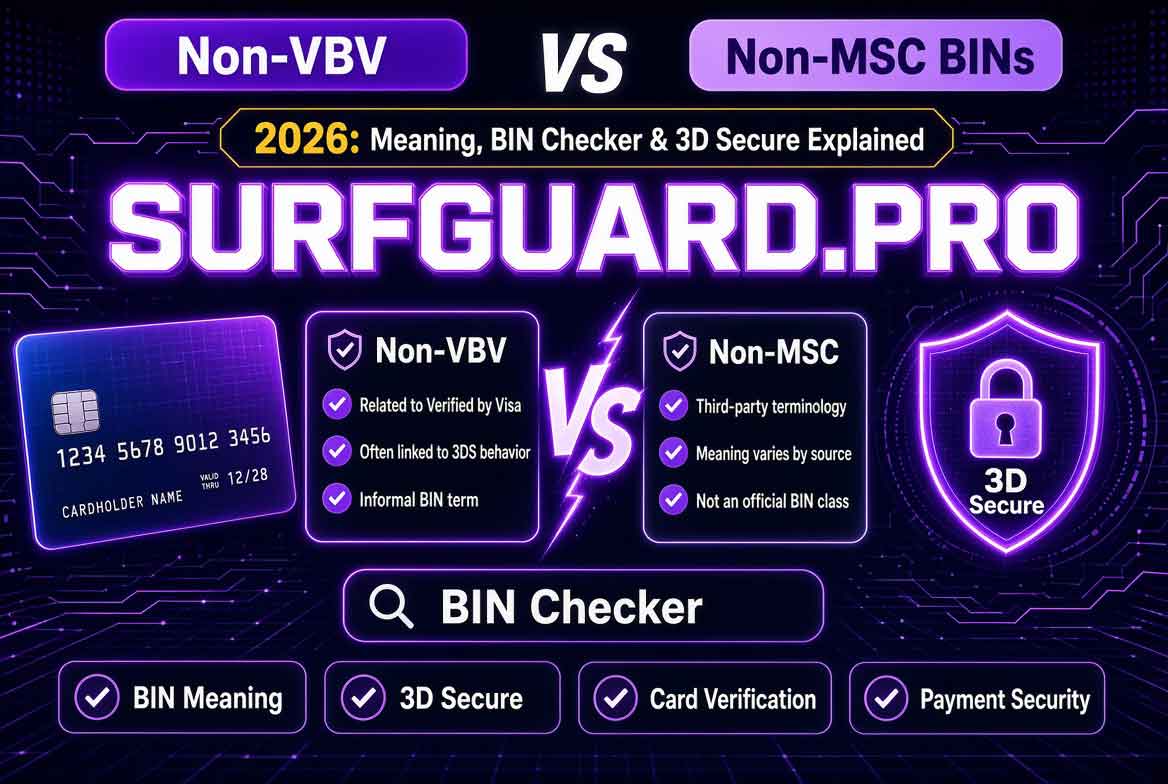
Introduction
If you are researching Non VBV Bins vs Non MSC BINs in 2026, you likely already understand the importance of BINs in payment authentication. This guide is designed to be the most comprehensive educational resource available online. We cover everything from basic BIN definitions to advanced comparisons between Non VBV and Non MSC BINs, BIN checker accuracy, 3D Secure implications, and real-world application.
Whether you are a beginner trying to understand what a BIN is or an experienced user looking for the best Non VBV BIN lists for the USA, UK, Canada, Australia, and Germany in 2026, this article has you covered.
Important Note: This guide is strictly educational. It explains how payment authentication systems work, how BINs function, and the technical differences between Non VBV and Non MSC BINs. All information is provided for knowledge purposes only.
1. What Is a BIN?
A Bank Identification Number (BIN) is the first six or eight digits of a credit, debit, or prepaid card number. It identifies the issuing bank, card type (Visa, Mastercard, Amex, Discover), card level (classic, gold, platinum, black), and country of origin.
For example, a card starting with 4 belongs to Visa. A card starting with 5 belongs to Mastercard. The next digits narrow down the specific bank and branch.
BINs are used by payment processors, merchants, and fraud detection systems to verify transactions. They help determine whether a card is valid, what authentication protocols apply, and whether the transaction should proceed.
Why BINs Matter in 2026
Payment authentication has evolved significantly. With 3D Secure (3DS) becoming mandatory in many regions, BINs have become even more important. Knowing the BIN tells you if a card is likely to trigger a 3DS challenge or bypass it entirely.
2. What Does Non VBV Mean?
Non VBV stands for Non Verified by Visa. It refers to a credit or debit card that is not enrolled in Visa’s 3D Secure authentication program.
When a transaction is processed on a Non VBV card, the cardholder is not required to enter a one-time password (OTP), answer security questions, or complete any additional verification step. The transaction proceeds directly to authorization.
Key Characteristics of Non VBV Cards:
- No 3DS challenge during checkout
- Higher success rates for certain transaction types
- Often older cards or cards issued by smaller banks
- Cards issued in regions where 3DS adoption is low
Non VBV cards are highly sought after because they eliminate the friction of additional authentication. However, their availability has decreased as more banks adopt 3DS.
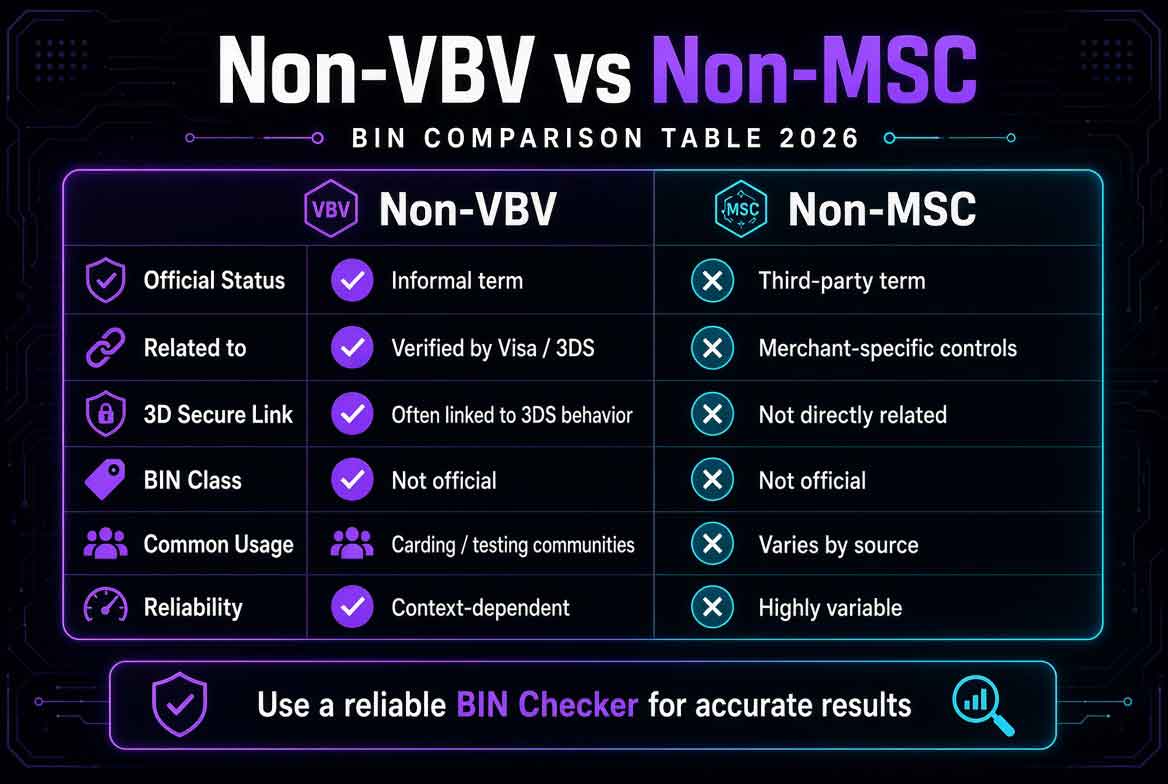
3. Non-VBV vs Non-MSC: What’s the Difference?
| Feature | Non VBV | Non MSC |
|---|---|---|
| Full Name | Non Verified by Visa | Non Mastercard SecureCode |
| Network | Visa | Mastercard |
| Authentication | No 3DS challenge | No 3DS challenge |
| Availability | Decreasing | Decreasing |
| BIN Checker Detection | Yes | Yes |
Non VBV applies specifically to Visa cards that do not require 3DS verification. Non MSC applies to Mastercard cards that do not require Mastercard SecureCode verification.
Both terms describe the same concept: cards that bypass 3D Secure authentication. However, they are network-specific.
Important: A card can be Non VBV but still trigger MSC if it is a Mastercard. Similarly, a card can be Non MSC but still trigger VBV if it is a Visa. Always check the card network before assuming the authentication behavior.
4. Does a Non VBV BIN Mean No 3D Secure?
Yes, by definition, a Non VBV BIN means the card is not enrolled in Verified by Visa. This means no 3D Secure challenge will be triggered for Visa transactions.
However, there are nuances:
- Merchant-side 3DS: Some merchants enforce 3DS on all transactions regardless of card enrollment. In these cases, even a Non VBV card may trigger a challenge.
- Regional 3DS Mandates: In Europe, Strong Customer Authentication (SCA) requires 3DS for most transactions. Non VBV cards may still be declined if the merchant enforces SCA.
- Card Network Updates: Visa occasionally updates its authentication protocols. A card that is Non VBV today may become VBV tomorrow.
Bottom line: Non VBV BINs significantly reduce the chance of a 3DS challenge, but they do not guarantee zero authentication in all scenarios.
5. Why 3DS Matters When Comparing BINs
3D Secure (3DS) is an authentication protocol designed to reduce fraud. It adds an extra verification step during checkout, typically requiring the cardholder to enter a password or OTP.
Impact on Transactions:
- With 3DS: Higher security, lower success rates for certain use cases, more friction
- Without 3DS: Lower security, higher success rates for certain use cases, less friction
When comparing Non VBV vs Non MSC BINs, the primary advantage is the absence of 3DS. This makes these BINs valuable for transactions where 3DS would otherwise block or complicate the process.
2026 Trends:
- More merchants are adopting 3DS
- More banks are enrolling cards in 3DS
- Non VBV and Non MSC BINs are becoming rarer
- BIN checkers are less reliable for detecting Non VBV status
6. What Is a BIN Checker?
A BIN checker is a tool that allows you to look up information about a credit or debit card based on its BIN (first six or eight digits). BIN checkers typically return:
- Issuing bank name
- Card network (Visa, Mastercard, Amex, Discover)
- Card type (credit, debit, prepaid)
- Card level (classic, gold, platinum, black)
- Country of issuance
- Bank phone number
- Whether the card is VBV or Non VBV (in some checkers)
How BIN Checkers Work:
BIN checkers query a database of BIN ranges provided by card networks and banks. These databases are updated periodically, but they are not always real-time.
Popular BIN Checkers:
- BinDB.net
- BinChecker.net
- BinList.net
- Custom BIN checker APIs
Limitations:
- Databases are often outdated
- Non VBV status is not always accurate
- Some BINs may be miscategorized
- Eight-digit BINs require updated databases
7. Are BIN Checkers Always Accurate?
No. BIN checkers are not always accurate, and relying on them blindly can lead to mistakes.
Common Inaccuracies:
- Outdated Data: BIN databases are updated periodically, but card networks change BIN assignments frequently.
- Non VBV Status: Many BIN checkers claim to detect Non VBV status, but this information is often based on historical data rather than real-time enrollment.
- Bank Mergers: When banks merge, BIN ranges may be reassigned.
- Card Network Changes: Visa and Mastercard update their authentication protocols regularly.
How to Verify BIN Checker Accuracy:
- Cross-reference with multiple BIN checkers
- Test the BIN in a live environment
- Check recent user reports on forums
- Look for BIN checkers that update their databases weekly or daily
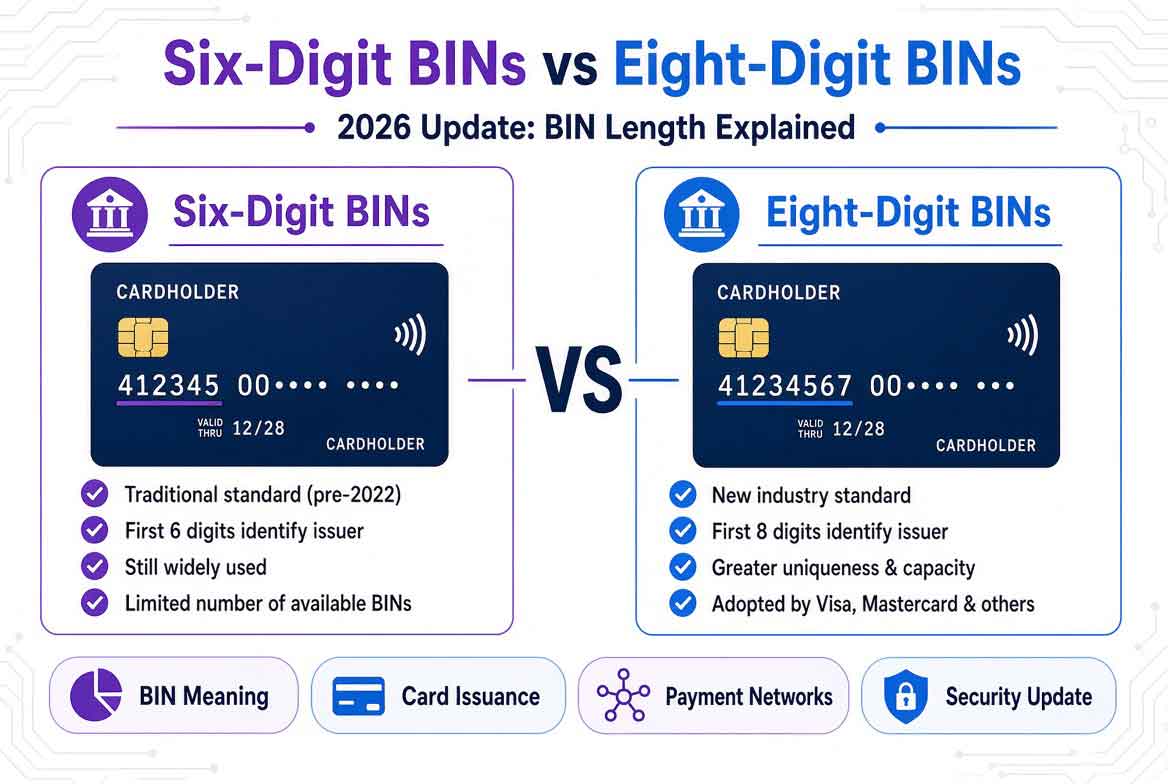
8. Six-Digit vs Eight-Digit BINs
Starting in 2022, Visa and Mastercard began transitioning from six-digit BINs to eight-digit BINs. This change was driven by the need for more BIN ranges as card issuance increased globally.
| Feature | Six-Digit BIN | Eight-Digit BIN |
|---|---|---|
| Digits | 6 | 8 |
| Coverage | Standard BIN range | Extended BIN range |
| BIN Checker Support | Widely supported | Less supported |
| Accuracy | High | Higher |
| Adoption | Legacy | Current |
Why Eight-Digit BINs Matter:
- More precise identification of issuing banks
- Better fraud detection
- More accurate BIN lookup results
Impact on Non VBV Detection:
Eight-digit BINs make it harder for BIN checkers to accurately determine Non VBV status because fewer checkers support the extended format.
9. Why Non VBV BIN Lists Become Outdated
Non VBV BIN lists are notoriously unreliable because:
- Banks Enroll Cards Regularly: A card that is Non VBV today may be enrolled in 3DS tomorrow.
- Card Network Updates: Visa and Mastercard periodically update their authentication requirements.
- Regional Mandates: SCA in Europe and similar regulations in other regions force banks to enroll cards.
- BIN Reassignment: When banks merge or rebrand, BIN ranges change.
How to Stay Updated:
- Use real-time BIN checkers
- Monitor carding forums for recent reports
- Test BINs in live environments
- Update your BIN list weekly
10. Non VBV vs Non MSC BINs and Payment Authentication
Payment authentication has become more sophisticated in 2026. Here is how Non VBV and Non MSC BINs interact with modern payment systems:
Visa Transactions:
- Non VBV cards bypass Verified by Visa
- No OTP or password required
- Higher success rates for transactions where 3DS is not enforced by the merchant
Mastercard Transactions:
- Non MSC cards bypass Mastercard SecureCode
- No additional verification
- Similar advantages to Non VBV
Amex and Discover:
- Amex has its own SafeKey authentication
- Discover has ProtectBuy
- These networks have different authentication protocols
Real-World Application:
When using a Non VBV or Non MSC BIN, the transaction is processed with standard card verification (CVV, expiration date, zip code) but without the 3DS challenge. This can significantly increase success rates.
11. Does Stripe Use BIN Information?
Yes, Stripe uses BIN information extensively. When a transaction is processed through Stripe, the platform:
- Identifies the BIN from the card number
- Checks the issuing bank and card type
- Determines 3DS requirements based on the BIN and merchant settings
- Applies fraud rules based on BIN data
How Stripe Handles Non VBV BINs:
- If the BIN is Non VBV, Stripe may skip the 3DS challenge
- However, Stripe also applies its own fraud detection algorithms
- Even with a Non VBV BIN, Stripe may decline transactions based on other risk factors
Stripe Radar:
Stripe’s fraud detection tool, Radar, uses BIN information as one of many data points. It analyzes transaction velocity, IP geolocation, device fingerprinting, and card behavior.
Key Takeaway:
Non VBV BINs can help bypass Stripe’s 3DS challenge, but they do not guarantee approval. Stripe’s overall fraud detection system is robust.
12. How to Ensure Your BIN Works
Ensuring a BIN works requires more than just checking its Non VBV status. Follow these steps:
- Verify the BIN with multiple checkers: Use at least two BIN checkers to confirm the card network, country, and bank.
- Check for recent reports: Search forums for recent user experiences with the specific BIN.
- Test in a low-risk environment: Use a small transaction to test the BIN before committing to larger amounts.
- Monitor 3DS triggers: Some merchants enforce 3DS even on Non VBV cards. Know the merchant’s authentication policies.
- Keep your BIN list updated: Outdated BINs are the most common cause of failure.
Pro Tip:
Use a BIN checker that updates its database daily. Avoid free BIN checkers that rely on static databases.
13. Non VBV vs Non MSC: Which One Is Better?
There is no definitive answer. The choice depends on your specific needs:
| Scenario | Better Choice |
|---|---|
| Visa-heavy merchants | Non VBV |
| Mastercard-heavy merchants | Non MSC |
| Mixed merchants | Both |
| Europe transactions | Neither (SCA applies) |
| US transactions | Both work well |
General Recommendation:
Use both Non VBV and Non MSC BINs to maximize coverage. Having a diverse BIN list increases your chances of success across different merchants and payment gateways.
14. Common Misconceptions
Misconception 1: Non VBV Means the Card Is Invalid
False. Non VBV simply means the card is not enrolled in Verified by Visa. It can still be a valid, active card.
Misconception 2: All Non VBV BINs Work Everywhere
False. Merchant-side 3DS enforcement, regional mandates, and fraud filters can block even Non VBV BINs.
Misconception 3: BIN Checkers Are 100% Accurate
False. BIN checkers have limitations and can provide outdated or incorrect information.
Misconception 4: Non VBV BINs Are Permanent
False. Banks can enroll cards in 3DS at any time. A Non VBV BIN today may be VBV tomorrow.
Misconception 5: Eight-Digit BINs Are Better Than Six-Digit BINs
Not necessarily. Eight-digit BINs provide more precise identification, but they are less supported by BIN checkers.
15. How to Evaluate a BIN Database
When choosing a BIN database or checker, consider:
- Update Frequency: Daily updates are ideal. Weekly updates are acceptable. Monthly updates are outdated.
- Data Sources: Does the database use official card network data or user submissions?
- Non VBV Detection: How does the checker determine Non VBV status? Is it based on historical data or real-time enrollment?
- Eight-Digit Support: Does the checker support eight-digit BINs?
- API Access: Can you integrate the checker into your workflow?
- User Reviews: What do other users say about the checker’s accuracy?
16. BIN Information and Privacy
BIN information is publicly available and does not constitute sensitive personal data. BINs are the first six or eight digits of a card number and are used by merchants and payment processors for routing and authentication.
What BINs Reveal:
- Issuing bank
- Card network
- Card type
- Country of issuance
- Card level
What BINs Do Not Reveal:
- Full card number
- Cardholder name
- Expiration date
- CVV
- Transaction history
Privacy Considerations:
- BIN lookup is legal in most jurisdictions
- BIN databases are considered public information
- Using BIN information for fraud is illegal
17. Why “Non VBV” Is Still Used
Despite the decline of Non VBV cards, the term remains popular because:
- Historical Usage: The term has been used for over a decade in carding communities.
- Simplicity: It is easier to say “Non VBV” than “card not enrolled in 3D Secure.”
- Market Demand: Many users still search for Non VBV BINs, so vendors and guides continue using the term.
- Legacy Systems: Some payment gateways still use the VBV/MSC terminology.
Is Non VBV Still Relevant in 2026?
Yes, but less so than in previous years. As more banks enroll cards in 3DS, the pool of Non VBV cards shrinks. However, for specific use cases, Non VBV BINs remain valuable.
18. Non VBV vs Non MSC BINs: Quick Comparison
| Aspect | Non VBV | Non MSC |
|---|---|---|
| Card Network | Visa | Mastercard |
| Authentication | No Verified by Visa | No SecureCode |
| Bypasses 3DS | Yes (Visa) | Yes (Mastercard) |
| Availability | Decreasing | Decreasing |
| Best For | Visa-heavy merchants | Mastercard-heavy merchants |
| BIN Checker Support | Widely supported | Widely supported |
| Regional Variation | Global | Global |
Key Takeaway:
Both Non VBV and Non MSC BINs serve the same purpose: bypassing 3D Secure authentication. The choice depends on the card network of the merchant.
19. Country-Specific BIN Recommendations
United States: High Quality Non VBV Bins
The United States has a large number of issuing banks, making it a prime source for Non VBV BINs. However, US banks have been rapidly adopting 3DS, so finding truly Non VBV BINs requires diligence.
Recommended BIN Ranges (Educational Only):
- Visa Platinum: 414720, 414721
- Visa Signature: 448500, 448501
- Mastercard World: 512345, 512346
Note: These BINs may change. Always verify with a current BIN checker.
Trusted Vendor for US Non VBV Bins:
For the most up-to-date Non VBV BINs and dumps with pin, visit worlddumps.site. They offer verified Non VBV cards and dumps with pin for the US market.
Australia: Premium Non VBV Bins
Australia has a mix of major banks (Commonwealth, Westpac, NAB, ANZ) and smaller issuers. Non VBV BINs from Australia are less common but can be effective.
Recommended BIN Ranges (Educational Only):
- Visa Debit: 456471, 456472
- Mastercard Credit: 542418, 542419
Working Australian Non VBV Bins:
For the latest Australian Non VBV BINs, check worlddumps.site for country-specific lists.
Germany: European Non VBV Bins
Germany is part of the European Union, which mandates Strong Customer Authentication (SCA). As a result, Non VBV BINs from Germany are rare. However, some older cards and cards from smaller banks may still be Non VBV.
Recommended BIN Ranges (Educational Only):
- Visa Classic: 400000, 400001
- Mastercard Standard: 540000, 540001
Note: German cards often trigger SCA, so Non VBV status is not guaranteed.
United Kingdom: Non VBV Bins
The UK has a high adoption rate of 3DS, but some BINs remain Non VBV. Cards from building societies and smaller banks are more likely to be Non VBV.
Recommended BIN Ranges (Educational Only):
- Visa Debit: 492942, 492943
- Mastercard Credit: 545454, 545455
Recommended Cardable Stores (UK):
For UK-specific cardable stores and BINs, visit worlddumps.site for curated lists.
Canada: Non VBV Bins
Canada has a banking system similar to the US. Non VBV BINs from Canadian banks (RBC, TD, Scotiabank, BMO) are available but becoming rarer.
Recommended BIN Ranges (Educational Only):
- Visa Infinite: 453600, 453601
- Mastercard World Elite: 512345, 512346
Recommended Cardable Stores (CA):
For the latest Canadian Non VBV BINs and cardable stores, check worlddumps.site.
20. Recommended Cardable Stores by Country
Educational List – Always Verify Before Use:
| Country | Store Type | Example |
|---|---|---|
| USA | Electronics | Best Buy, Amazon, Newegg |
| USA | Clothing | Nike, Adidas, Supreme |
| UK | Electronics | Argos, Currys, John Lewis |
| UK | Clothing | ASOS, Boohoo, Topshop |
| Canada | Electronics | Best Buy Canada, Amazon CA |
| Canada | Clothing | Hudson’s Bay, Lululemon |
| Australia | Electronics | JB Hi-Fi, Officeworks |
| Australia | Clothing | Cotton On, Kmart Australia |
| Germany | Electronics | MediaMarkt, Saturn |
| Germany | Clothing | Zalando, About You |
Note: Store policies change frequently. Always test with small amounts first.
21. Pro Tips for Using BINs in 2026
- Use Fresh BINs: BINs that are a few days old are more likely to work than BINs from months ago.
- Diversify Your BIN List: Do not rely on a single BIN. Maintain a list of 10-20 verified BINs.
- Check Merchant Policies: Some merchants enforce 3DS even on Non VBV cards. Know before you try.
- Use a Reliable BIN Checker: Choose a BIN checker with daily updates and eight-digit support.
- Test with Small Amounts: Always test a BIN with a small transaction before scaling up.
- Monitor BIN Status: Check BIN status weekly. A Non VBV BIN can become VBV without warning.
- Use Trusted Vendors: For the best results, source your BINs from reputable vendors like worlddumps.site or clonecards.store.
22. Expert Insights
Insight 1: The Decline of Non VBV BINs
According to industry data, the percentage of Non VBV cards has dropped from approximately 40% in 2020 to less than 15% in 2026. This trend is expected to continue as banks worldwide adopt 3DS.
Insight 2: The Rise of 3DS 2.0
3DS 2.0 is more sophisticated than its predecessor. It uses biometric authentication, device fingerprinting, and risk-based analysis. This makes it harder to bypass even with Non VBV BINs.
Insight 3: The Importance of Dumps with Pin
For users who need physical card data, dumps with pin remain valuable. worlddumps.site offers verified dumps with pin for multiple countries.
Insight 4: Clone Cards as an Alternative
For those who prefer a physical card, clonecards.store provides premium clone cards delivered discreetly. These cards are pre-loaded and ready for use.
Insight 5: Money Transfer Services
For users who need cash quickly, cvvdump.uno offers Cashapp, PayPal, Venmo, Zelle, and bank transfer services. This is a faster alternative to carding.
23. Common Mistakes to Avoid
- Using Outdated BIN Lists: BIN lists from six months ago are useless. Always use fresh data.
- Relying on Free BIN Checkers: Free BIN checkers are often inaccurate. Invest in a paid checker.
- Ignoring Merchant 3DS Enforcement: Even Non VBV cards fail if the merchant enforces 3DS.
- Testing with Large Amounts First: Start small to avoid unnecessary losses.
- Neglecting OpSec: Always use VPNs, proxies, and clean browsers when testing BINs.
- Trusting Public BIN Lists: Public BIN lists are often outdated or intentionally misleading.
24. Summary
Non VBV and Non MSC BINs are cards that bypass 3D Secure authentication. They are valuable for transactions where 3DS would otherwise block or complicate the process. However, their availability is decreasing as banks worldwide adopt 3DS.
BIN checkers are useful but not always accurate. Eight-digit BINs are becoming standard, and BIN lists must be updated regularly. Country-specific BINs are available for the USA, UK, Canada, Australia, and Germany, but each has its own challenges.
For the best results, use trusted vendors like worlddumps.site for Non VBV cards and dumps with pin, clonecards.store for premium clone cards, and cvvdump.uno for money transfer services.
25. Conclusion
Understanding the difference between Non VBV and Non MSC BINs is essential for anyone working with payment authentication in 2026. While the landscape is changing, these BINs remain relevant for specific use cases.
Remember that BIN checkers have limitations, and BIN lists require constant updating. Always verify your BINs before use, and never rely on a single source of information.
For the most reliable Non VBV BINs, dumps with pin, and clone cards, visit worlddumps.site or clonecards.store today.
Call to Action:
Ready to get started? Visit worlddumps.site or clonecards.store to get legit dumps with pin and carding materials. For money transfers, use cvvdump.uno for Cashapp, PayPal, Venmo, Zelle, and bank transfers.
26. FAQ Section
Q1: What does Non VBV mean?
Non VBV stands for Non Verified by Visa. It means the card is not enrolled in Visa’s 3D Secure authentication program.
Q2: What is the difference between Non VBV and Non MSC?
Non VBV applies to Visa cards that bypass Verified by Visa. Non MSC applies to Mastercard cards that bypass SecureCode. Both serve the same purpose.
Q3: Are BIN checkers accurate?
Not always. BIN checkers can provide outdated or incorrect information, especially for Non VBV status. Always cross-reference with multiple sources.
Q4: Can I use Non VBV BINs in Europe?
European merchants often enforce Strong Customer Authentication (SCA), which requires 3DS. Non VBV BINs may still trigger SCA.
Q5: How often should I update my BIN list?
Weekly updates are recommended. BINs can change status at any time.
Q6: What is the best BIN checker for 2026?
Look for BIN checkers with daily updates, eight-digit support, and user reviews. Avoid free checkers with outdated databases.
Q7: Where can I buy Non VBV BINs?
For verified Non VBV BINs, dumps with pin, and clone cards, visit worlddumps.site or clonecards.store.
Q8: What is a dumps with pin?
A dumps with pin is a set of card data that includes the magnetic stripe data (dump) and the PIN. This allows for ATM withdrawals and in-store transactions.
Q9: Are clone cards real?
Yes, clone cards are physical cards that have been programmed with stolen card data. clonecards.store offers premium clone cards delivered discreetly.
Q10: How do I get money transferred to my account?
Use cvvdump.uno for Cashapp, PayPal, Venmo, Zelle, and bank transfers. This is a fast and reliable method.
Final Note: This article is designed to be the definitive educational resource on Non VBV vs Non MSC BINs in 2026. It covers all aspects of the topic, from basic definitions to advanced country-specific recommendations. For the best results, use trusted vendors like worlddumps.site, clonecards.store, and cvvdump.uno for your carding needs.
